#81: Lobbying for Ball
How My Brief Experience On Capitol Hill Scarred Me

As I walked through the halls of the U.S. Capitol building in 2014, two things struck me (neither a Jan. 6 rioter, rimshot).
First, it wasn’t as fancy as I expected. I grew up near Washington, D.C., and had visited it many times, including on school field trips. The Capitol, like the White House and other working and historical monuments, had always seemed bigger than life to me.
But I had never been in these back hallways of The Capitol and the connected buildings that housed members of Congress. While the marble floors shined, the passages themselves were nondescript, lined with door after door that opened into the offices of elected officials.
Second, for the first time in my life, I was in The Capitol on business. Ball Corporation had sent me to Washington, D.C., to lobby.
Lobbying wasn’t my job. But each year Ball would send someone in a leadership role to D.C. to accompany our actual lobbyist, John Campbell, as he made the rounds, visiting elected officials on both sides of the aisle to discuss a specific issue.
It was positioned as a reward, an opportunity to see how the gears of government moved and to witness Ball’s Political Action Committee (PAC) dollars at work.
I eagerly jetted east from Colorado, looking forward to the experience.
A few days later, I left D.C. deflated and sad – despite the valiant efforts of John, who I’m sure had seen this reaction before.
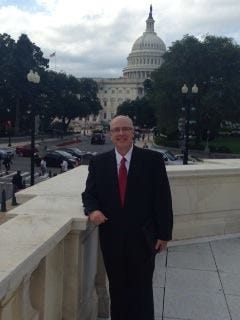
The issue we were there to discuss with elected officials was the renewal of a research and development tax credit. Basically, companies that explored new processes and technology could get a tax write off from the Internal Revenue Service as a way to reward initiative.
The concept wasn’t controversial. The fact it offered a tax write off to companies, however, had become a bit of a political football.
In a world increasingly uninterested in context, the R&D tax credit was viewed by some as a boondoggle for corporations that already enjoyed too many advantages. To companies charged with making a profit, the tax credit both lowered their taxes and provided a financial incentive to try new things. [Note: How genuinely some companies did so was, and is, certainly a topic for debate.]
John, our lobbyist, didn’t prep me much for our visits. He had done this so many times, I’m not sure he viewed what we were doing as particularly difficult. My presence may even had meant a light day for him.
For many years, John had mostly worked on aerospace projects as Ball’s lobbyist. While company sales came almost entirely from its global packaging (beverage, food and aerosol cans operations) business, Ball Aerospace and its pursuit and execution of complex government and defense contracts required far more support in D.C.
Not long before my 2014 trip, however, John’s work had expanded to my packaging world. The R&D tax credit had implications for both of Ball’s businesses, and so John as Batman and me as a very raw and somewhat idealistic Robin headed to the Hill.
[Note: John was the first person I had ever seen use Uber, or at least a car service summoned by a phone app. When he pulled out his phone in downtown DC and called us a car using his app during this trip, I was fascinated and somewhat dubious – until the car pulled up. Uber was still relatively new at the time and had come to D.C. in December 2011. I had never used it in the Denver suburbs. For city slicker John, though, it was old hat.]
We entered the Longworth House Office Building, joined a short queue, passed through metal detectors and then, in just a few steps, we were in. The long, wide hallways were mostly empty, though here and there you could see people loitering in open doorways as they finished a conversation inside before briskly heading off in one direction or another.
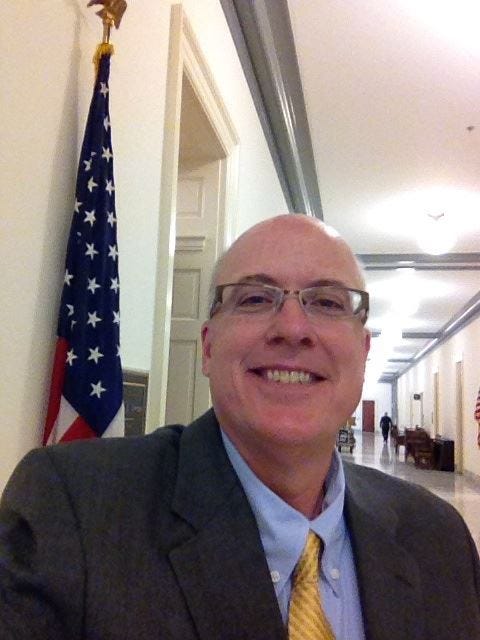
As we walked further inside, sometimes taking stairways to change floors, I saw small wall placards outside the doorways identifying the elected official within. A few names I recognized, most I did not. I’m not much of a policy wonk. [Note: When I first wrote that sentence I typed it as “policy wank,” and fortunately checked it. Totally different meaning.]
John had set up meetings with a half dozen or do officials, in both parties. As we stepped through doorways into the offices beyond, it was fascinating how each set up varied.
In some offices, you were confronted immediately by a staffer behind a desk, who greeted you and let you know how long it would be before you would be able to meet the Congress member beyond.
In larger offices, you might see two desks and other staff members, busily looking through files or working on terminals. Here and there they might be on a call, though privacy was at a minimum.
Almost all of the staffers were young. Most were under 35 or 30, many were in their 20s. Everyone dressed formally, with coat and ties for men and women often, but not always, in dresses and heels.
John would make brief asides to me when he could, placing these people in context as an intern, a senior staffer or, rarely, a chief of staff. Sometimes that was who we met with, as the elected official was elsewhere.
It was clear they all viewed us as merely another appointment on a calendar. While a few were friendly to John, who they knew from past visits, most had no interest in us beyond holding us in place and then, at the appropriate time, sending us through.
It was all very impersonal, and not at all how I thought meeting the team of an elected official would go.
I had also seen that mix of disinterest and glimmers of smugness before. I had run into it as an undergrad student at Virginia Tech, when I had to sort out a class requirement issue to graduate. And at the local DMV. And even today, when I finally battle my way through all the voicemail prompts trying to steer me to basic answers to simple questions when my issue is more complex and requires a human to sort out.
It was the bored look of officialdom, from people who had other things they wanted to do. It didn’t give me the warm and fuzzies.
Soon, after 3-4 visits to different offices, a pattern became apparent.
When we met with a Republican representative, they listened politely to our message regarding the R&D tax credit, usually nodding along. At the end they affirmed their support and showed us the door.
When we met with a Democratic representative, they had little to no interest in our topic. They wanted to talk about whether we might build a new plant in their district, or otherwise support one of their pet projects. The non sequitur confused me at first, but I quickly became used to it. Sometimes the Democratic official never even provided a firm answer on their stance on the tax credit.
John handled all of these discussions professionally and politely. After we would leave an office, I would ask him questions about what happened and why.
Sometimes there was a back story explaining the discussion, sometimes John would shrug. “This is the way it works,” he seemed to be saying.
The more meetings we had, the more obvious that pattern became. By the end of the day, my disillusionment was palpable.
And it wasn’t only about the Democratic reaction. The lack of discussion with Republican officials indicated that their support was a foregone conclusion, because of course it would be. Why then were we even talking?
And remember, this was in 2014 when there still was a traditional Republican party. I was experiencing an American government much less polarized than today. I wonder if Dems would even let us into their office now.
I was naïve, I know. That’s often my weak point, that I believe people and institutions care about who and what they represent. Whether you provide customer service or political support, I assume people will do the best they can because that’s part of the job.
That day, I realized that elected officials truly are like everyone else. Their titles and roles don’t mean they act with a higher purpose. Oh, I’m sure some do. But not nearly as many as I had thought.
I don’t know how John copes with it. He has to face it every day. It’s his job.
He and I discussed that topic afterward on that visit, and several other times over the years after that. I won’t share those discussions here.
At times, however, I sensed a sort of resignation in him that what I experienced was just the way government operated. I suppose that comes with being a professional lobbyist.
And that’s a loss for all of us.