
#80: Home-Reno Lessons
What Doesn't Kill You Still Sucks

Take it from me. you want to make sure - absolutely sure - that your home’s roof is rock solid.
Because the journey from “Hey, what’s that dripping sound?” to returning to “normal” is a long and exhausting one. I’d compare it to climbing Everest, but reno takes more time.
And if you have a significant roof leak? Well, there’s a reason that people say that when it comes to home restoration, what you actually demolish is your sanity.
[Note: These are first-world problems. Russia isn’t sending drones to bomb my town, ebola isn’t at my local hospital (yet) and for that and more I’m grateful. They say write what you know. What you’re reading is the next best thing.]
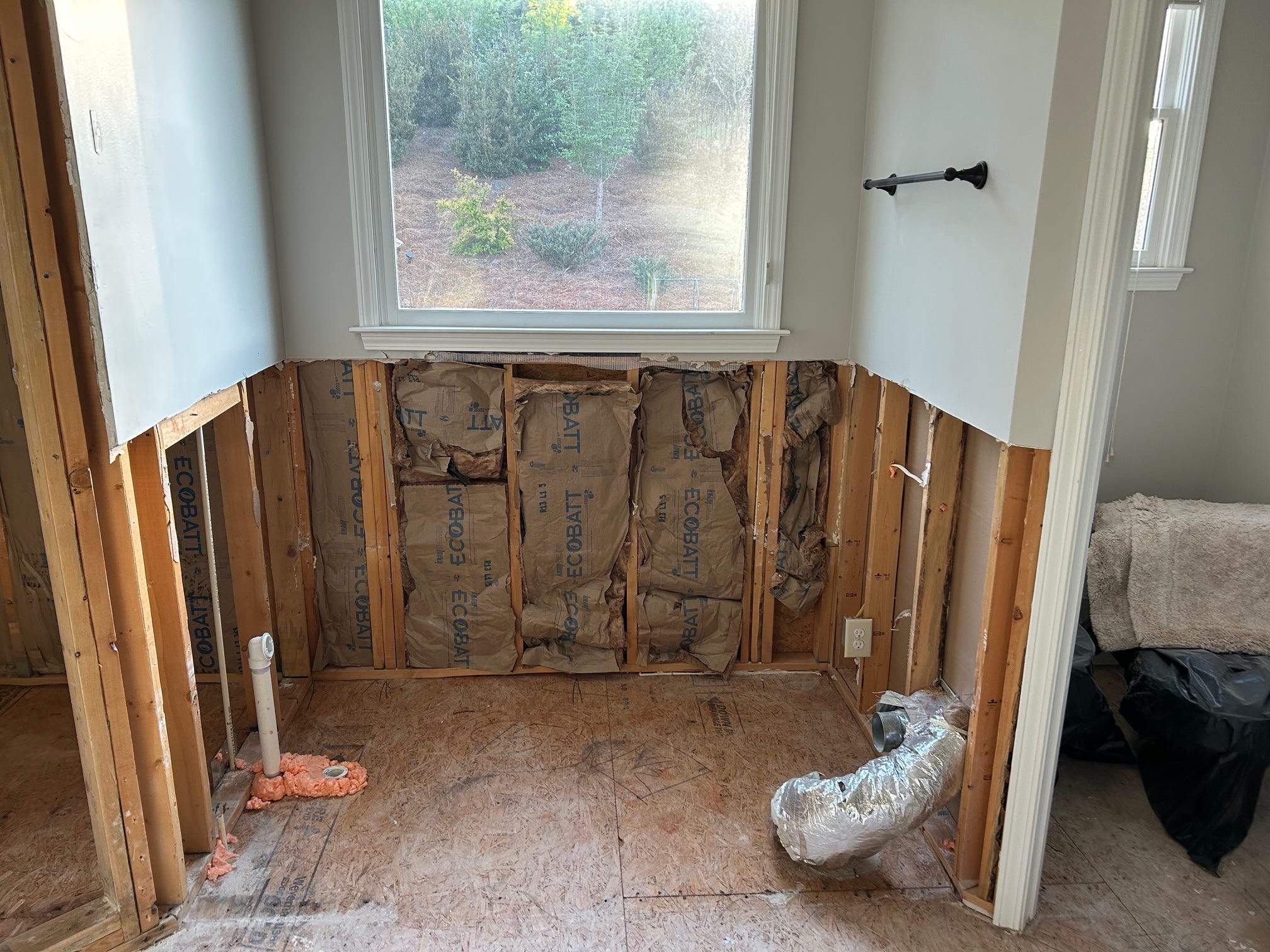
It started back in January, when a rare ice storm in North Georgia created ice dams on the north side of our roof. It poured rain the next day, and the dams backed up water on the roof and in the ice-filled gutters. The water flowed back inside the house, first across ceilings and then down walls and ultimately spreading on subfloors under wood and tile.
In all, we had ceiling, wall and floor damage in three separate locations, from primary bathroom to finished basement.
In Colorado I might have elected for spot repairs, to save time and money. But mold is real in Georgia, and multiple people warned me not to go cheap on addressing what would likely become a bigger problem later if we didn’t take care of the water issue now.
So we went full-on remediation - ripping out dry wall, wood and tile and running dehumidifiers and very loud fans, sometimes four to a room, nonstop for days.
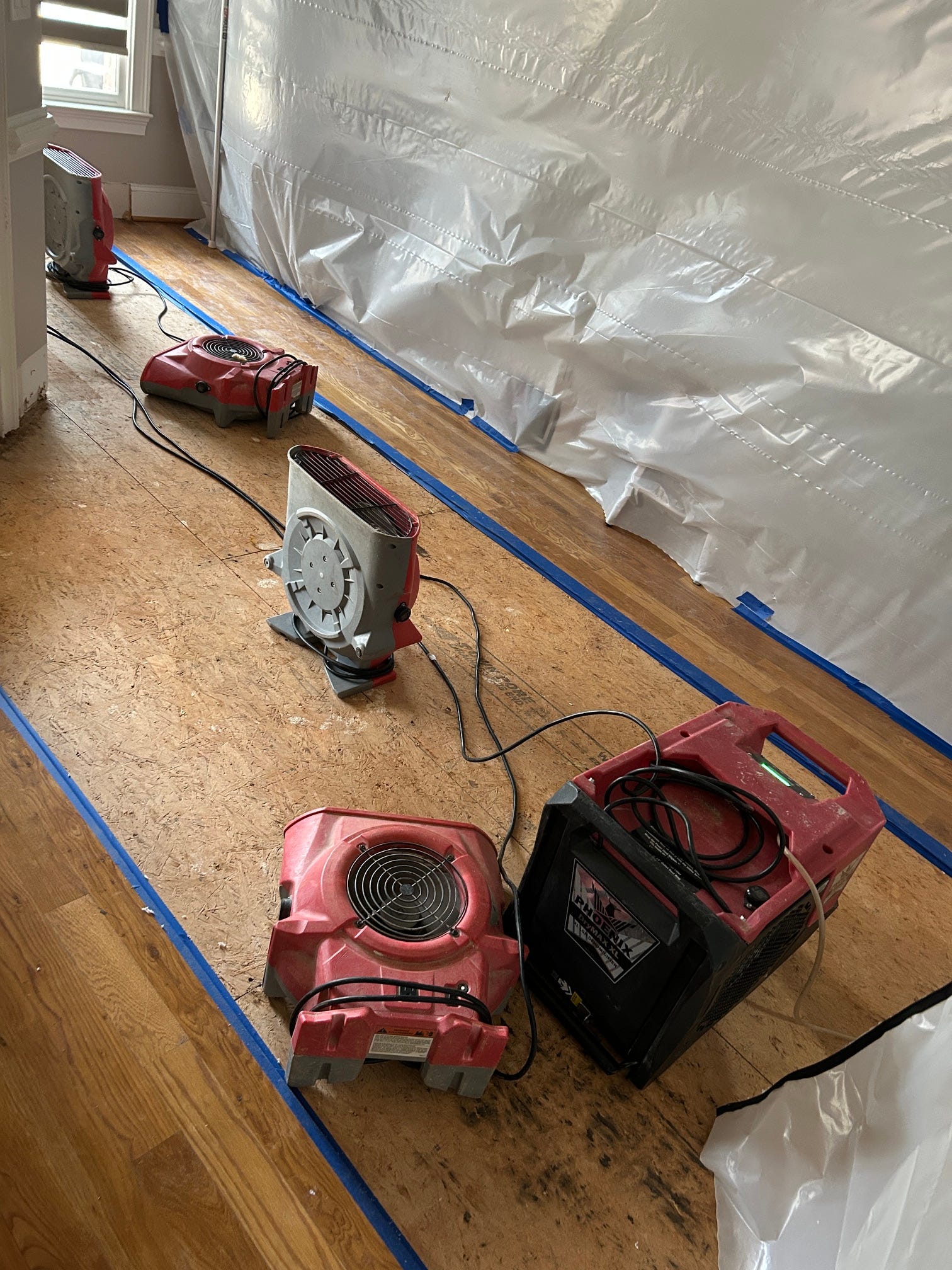
It sounded like we lived on an airport jetway, and it was maddening. The remediation locations were spaced apart just right, so that there was nowhere in the house you could go to escape the noise. Somehow we made it through four days of that, not realizing it was only the tip of a very large and slow-moving iceberg.
Then, just a few weeks after remediation finished drying that multi-part leak, we heard another drip - this one toward the front of the house in a different bathroom. Turned out the 12-year-old grout in a tile shower bench and wall niche had given way. Water from the running shower flowed down under that bathroom’s tile as well as into a (thankfully) mostly unfinished basement space.
That meant more fans, more dehumidifiers, more plastic sheeting and more blue painter’s tape to wall off damaged areas.
Meanwhile, the insurance games were underway.
Every remediation guy and contractor we met asked us almost immediately who our insurance company was. When we replied “State Farm,” they all frowned and shook their heads, then said some version of this: “State Farm used to be easy to work with, but over the last (insert time span, ranging from 6 months to 2 years) they have been terrible, penny-pinching you for every little thing.”
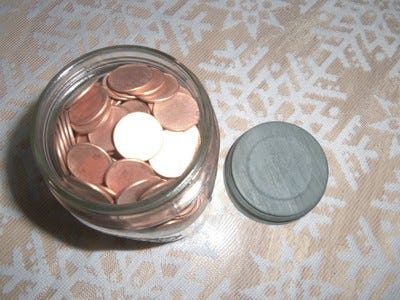
[Interesting sidebar: For many years, Ball Corporation owned the business that made zinc blanks that were clad with copper and turned into U.S. pennies. Soon after I joined Ball in 1991, I became part of a series of discussions around whether the U.S. Treasury would stop making pennies. Lobbyists, including ours, fought back against efforts to eliminate the coin, and those efforts ended in no action being taken - until recently. Ball long ago spun off those zinc operations. Still, I wonder what the current owners think of the penny going away today, and who it will affect. More than that, I wonder how long it will be before people no longer understand what “penny-pinching” means.]
[Which Leads Me To: Speaking of government contracts, I understand why some people say the federal government can be wasteful. In my 32 years at Ball, I only once came across a canmaking product linked to a government contract - a single line in a former Ball Baltimore plat that made what was called “foxhole in a can.” My understanding was the can we made would later hold a shaped charge that could quickly create a workable foxhole for soldiers. Now, most Ball packaging lines need very few people to run. It’s automated, high-speed machinery and if you walked a line that might be 100 yards long it’s possible you would see no one at all, even if 3-5 employees were around to maintain machines and check on any issues. When I first saw the foxhole-in-a-can production line in Baltimore, I was dumbfounded. There was an employee stationed every 5-10 feet, at least 15 people along what was a fairly short line, most standing and watching the line run. It surprised me so I asked a senior exec why so many people were there. “Government contract,” was the answer, with a small smirk. Government work can be as much about jobs as efficiency or quality.]
[That Reminds Me: I should write about the time I went to Washington, D.C., and accompanied Ball’s lobbyist on visits to members of Congress. It was depressing.]
Back to State Farm … I should be clear: State Farm has not penny-pinched in our case (at least to date, we are not quite finished), and aside from being difficult to contact the insurance company evaluated, approved and paid for our claim with a minimum of fuss.
They did defy the bounds of logic by refusing to cover any roof work because, according to their expert, the roof wasn’t damaged. They said this while acknowledging that the roof failed and that failure enabled the leaks they did cover.
[Note: So what did I do? After arguing and losing, I ended up paying about $5,000 out-of-pocket for some roof upgrades intended to keep the same failure from happening again. I do not want to go through this a second time.]
Apparently we weren’t the only area policyholder with issues, because our case was assigned to a State Farm “catastrophe team.” At one point, our temporary adjuster, Antoine, showed up driving an office-on-wheels to take a look and later deliver a check. I never heard a word from my local State Farm agent.
[Note: Later State Farm replaced Antoine with Joshua for our claim, but neglected to tell me. I finally found out when I went to their text bot and it sent me completely different contact info than what we had been using for months for our claim.]
Meanwhile, the rotating crews of remediators had come and gone, picking up fans and other equipment and terrifying me with at times callous regard for spatial relations - i.e., how they maneuvered their big, metal boxes through our hallways and doorways.
This may be a “me thing,” but one of the most exhausting aspects of restoring a damaged home is trying to keep the people fixing it from causing more damage.
There is a hierarchy when it comes to tradespeople, ranging from highly skilled craftsmen at the top of the pyramid to basic laborers whose sole function is to move supplies and equipment from one location to another.
The latter don’t say much, they always want to know where your bathroom is and they struggle with tight spaces.
Those are the guys you have to watch. Because even with my frantic supervision, which I’m sure earned me a reputation as the “Karen” of our house, the following occurred during the 5-month remediation and rebuild process:
A demo crew accidently hauled away some of our bathroom towel racks and support bars (necessitating replacements that we solved by choosing to update all the fixtures).
Our stainless steel fridge was dented and scratched.
A set of window blinds that had been removed during painting was torn in half.
Another set of blinds in a different room ended up missing hardware, though I did find one piece on the front porch.
A window casing was broken off for an inch or so at a corner.
A dining room cabinet came apart as it was being moved back in (to be fair, its construction quality was dubious).
Our recently painted front door was gashed down to the paint color below it.
Paint was removed in the weirdest places high up on walls, from the too-quick removal of tape holding plastic barriers.
Small dings showed up everywhere, from the pantry to main hallways.
And that’s only what we have found so far. None of it was intentional. It was just from guys not being careful.
In any case, at times there were as many as four separate crews in our house. There might be a tile crew in a bathroom, a drywall crew in the living room, a demo crew in the basement and a painter or two in a hallway.
Crews would arrive at varying times in the morning, break randomly and sometimes disappear to get supplies, then leave for the day between 4 and 5 pm. Now and then, we would prepare for a crew we thought would arrive at 9 or 9:30 am and none would show. A call to the project manager an hour or so later would usually reveal a communications mix up.
During those comings and goings we had to seclude ourselves in the basement and manage our two dogs (one of whom we had just adopted and I’m sure was having second thoughts about joining us permanently). The dogs had to go out regularly on leashes, so we could more easily get around or through the crews.
It was exhausting, and confining. There were a few weeks where I left the house only once or twice, to volunteer at the horse rescue. I never felt comfortable leaving for long, as crews would arrive at varying times and needed access, and questions would come up regularly about details I needed to be available to answer.
Plus I had to, you know, supervise.
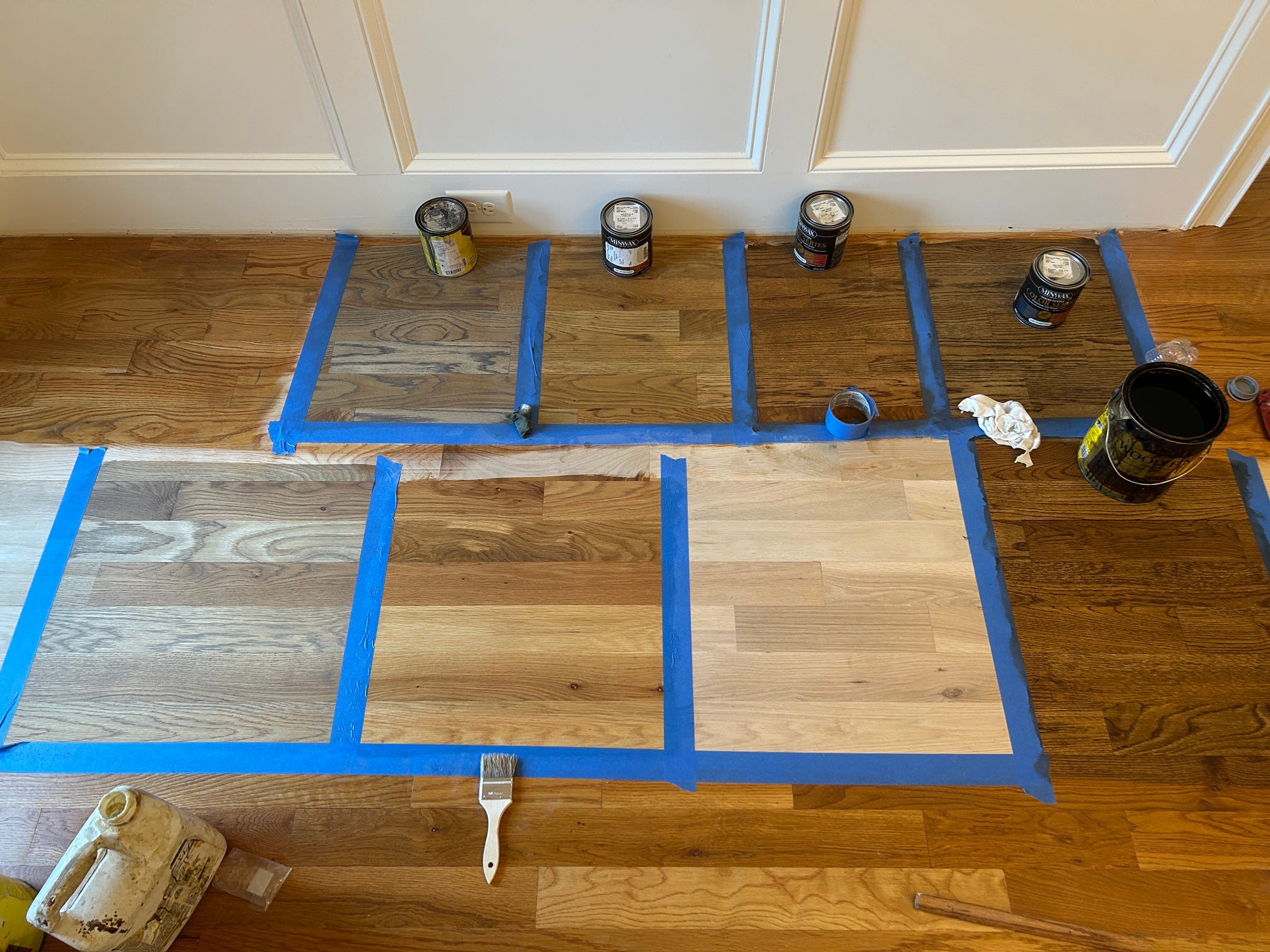
The culmination of this January-to-May process was the sanding and refinishing of our wood floors last week. We moved out for 7-10 days, along with our dogs, and cleared every piece of furniture off the wood floors that run through most of our home.
[Note: One of the guys who arrived to begin the wood floor sanding process had also been one of the remediation guys back in early February. His comment to me as he walked in: “Wow, is this the same issue, or did you have new ones?” He was stunned to hear it was the same project.]
We elected to pack and move most of our stuff ourselves, to our basement (movers can’t damage what they don’t move!). It was a lot of work. A lot.
Meanwhile, the search for a VRBO alone was a challenge, given we had dogs and needed a fence. After a few swings and misses (listings are vague on the existence of a back fence) we found the perfect place 35 minutes away, so that worked out even if it meant a lot of driving back and forth.
[Note: And we lucked out on the timing, as most of the VRBOs included language aimed at World Cup soccer fans traveling to Atlanta for matches next month, with hefty price increases to match].
You know how when you start painting a room you are full of excitement, and then with two walls done and two walls to go you just want to leave the paint brushes and go to Aruba? That’s where I am right now, as I survey our jam-packed basement and empty main floor.
But we have two basically new bathrooms, no more drywall holes and hopefully no hidden mold.
And Ivan the rescue dog chose to stay, and has joined fellow rescue and big sister, Nova.
They just have to get used to me yelling at them to not walk on our new floors.
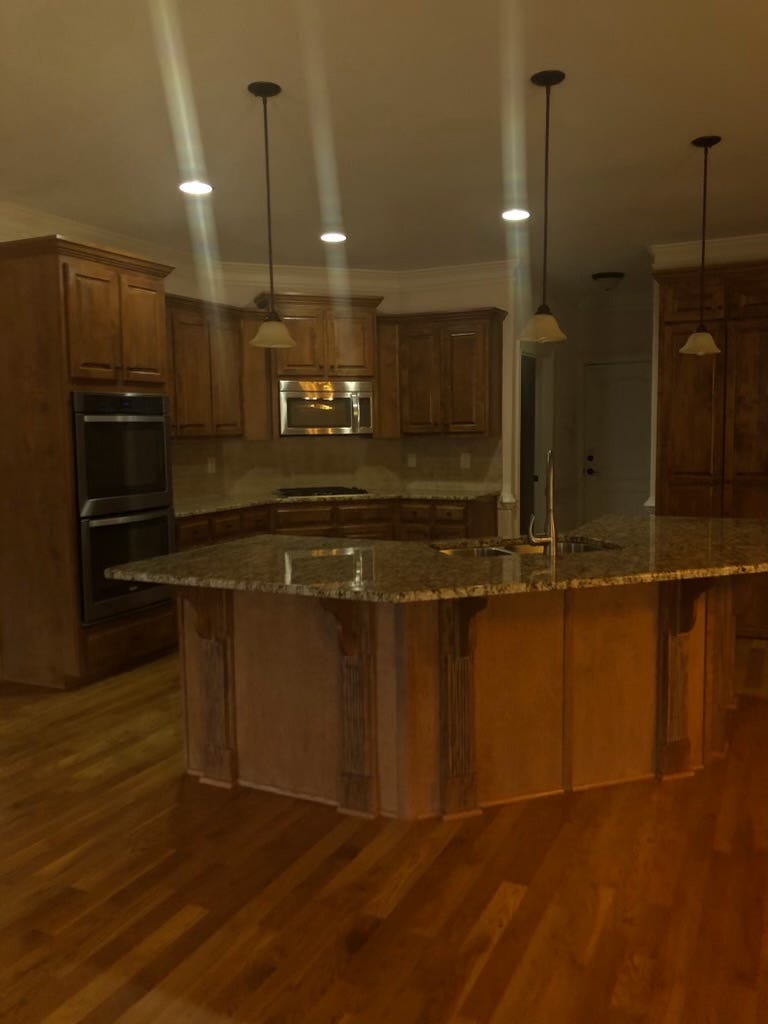
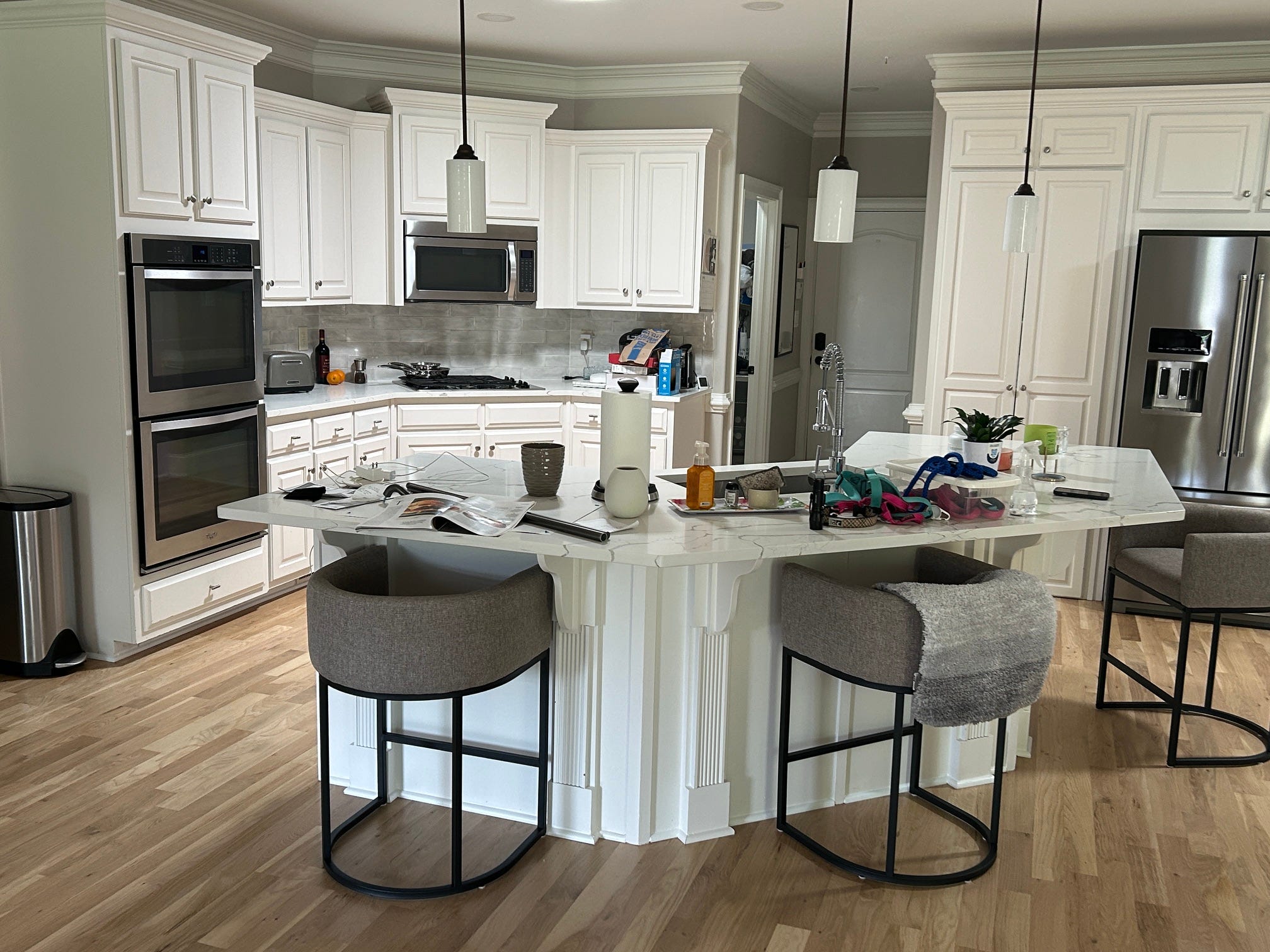
Love that kitchen.