
#82: Earth, Wind & ... Stickers
Also - In Praise of "Glue Guys"

A book arrived last week that I had ordered on a whim.
Rhythm & Fire is a relatively short memoir (less than 230 pages) by Earth, Wind & Fire percussionist and vocalist Ralph Johnson.
Back in my early teen years, when most of my peers were latching on to KISS and Boston, I grooved to EW&F. Perhaps because my stepfather, Mike Webber, was a professional bass player, music that emphasized the beat always drew me in.
And that preference started at an early age. In music appreciation class in elementary school, I liked Harry Belafonte. A few years later, the first song I remember being excited about when it came on the radio was Stevie Wonder’s “Superstition.”
The first tune I turned up the radio for as a preteen was “I’m Your Boogie Man” by KC and the Sunshine Band. The first album I bought was Parliament Funkadelic’s Funkentelechy Vs. the Placebo Syndrome because I loved the song, “Flashlight.”
And the band that drew me in and remained my favorite for decades was Earth, Wind & Fire.
So when I saw last month that Ralph Johnson was about to publish a book, I preordered.
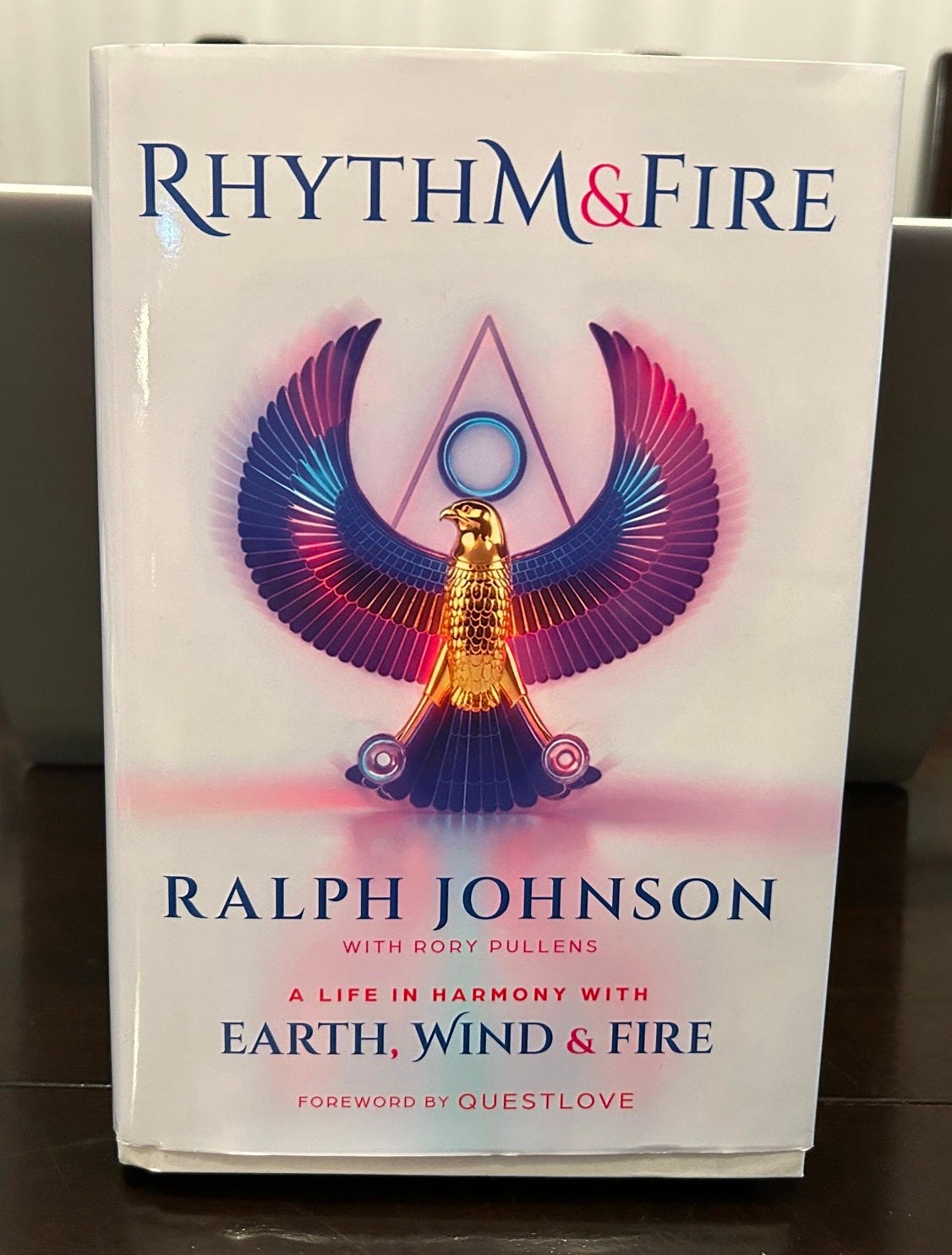
Few people outside of certain music circles recognize Ralph Johnson’s name. Though he was a founding member of EWF, even casual EWF fans would likely know little of Johnson.
He wasn’t the front man, Maurice White, who passed away in 2016 at age 74. Or his younger half-brother, bassist Verdine White, who continues to play today (and to whom I wrote a letter as part of a grade school exercise asking for tips on learning to play bass – alas, he never replied).
He’s probably less known even than Fred White, a band co-drummer and part of the same White family.
And he certainly is not as familiar as Philip Bailey, the co-vocalist with White whose distinctive falsetto was sometimes referred to by band members as “The Voice.”
But I’ve always been drawn to lesser-known, clearly talented people who are the glue that hold things together. Front men are great, but the people in the background who keep things moving intrigue me more.
That was true during my long career at Ball Corporation, of my ongoing rooting interest in sports teams and in my connection with music.
And Johnson fits that bill.
[Note: In the mid-90s, our communications and design team at Ball Corporation created a rotating honor we called the “Elmer Award” (see super professional video below, from my basement). Decorated black-and-white like a Holstein Cow, the small, plastic tube was presented to the person whose efforts that month most push the team forward and helped everyone accomplish their goals – the glue that kept things together. I was a proud recipient of the Elmer Award a number of times and greatly respect and understand people who are seen as “glue guys.”]
I’m still reading Johnson’s book, and am about halfway through as I write this. I’m taking it along with me on a weekend trip I’ll cover in a future substack entry.
But here’s the reason I bring it up at all: The book was signed - sort of.
It’s true that Ralph Johnson’s signature is in the book. But his signature is on a sticker, and that sticker is pasted onto a blank page up front.
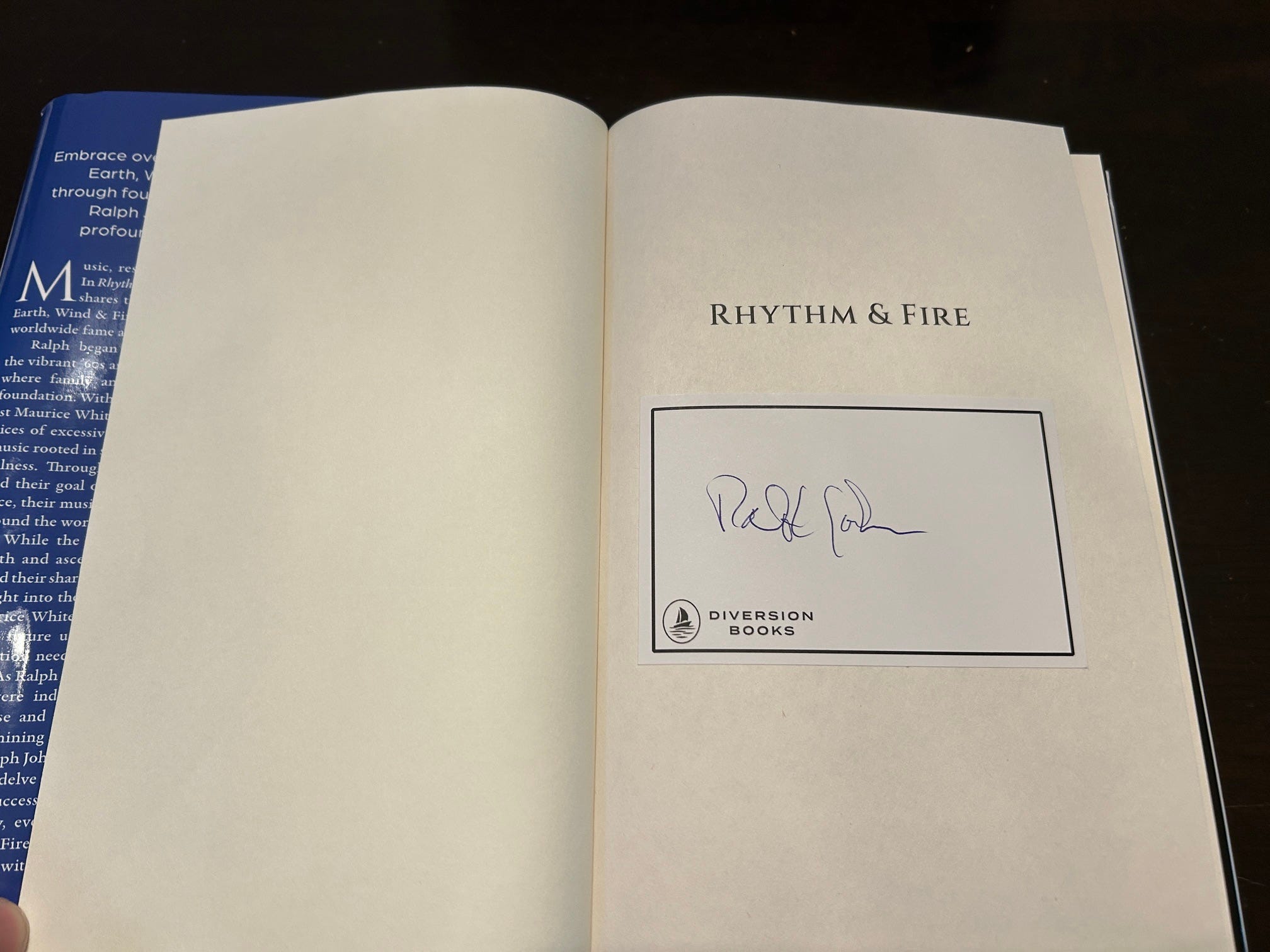
The sticker is one of those “My Name Is ...”-sized decals we used to scrawl our first name on (or full name, if you were a bit stuffy) and slap onto our shirts or sports coats at group meetings.
Apparently, Johnson simply signed sheet after sheet of stickers, and then someone carefully placed one sticker in each “signed” book.
The fact it was done that way makes me irritates me. I don’t have a signed copy of Rhythm & Fire. Johnson never signed my book. I have a signed sticker, placed inside my book.
Is that how signed books are done these days? I have a good number of signed books, from Gary Larson of The Far Side cartoons to Carey Ewes and a copy of The Princess Bride to a collection of poems from the former husband of a woman I met in California in the 80s who had a crush on Brian Dennehy (in fact, one of her ex-husband’s poems is titled, “My Wife’s In Love With Brian Dennehy”).
All of my signed books feature the author’s signature directly on a blank page of the book. None are signed stickers.
Is there a meaningful difference? It feels like one to me. Did Ralph Johnson know? He had to, given he signed the stickers.
I mean, I get the efficiency of the process. No need to ship heavy books around, when you can bundle much lighter sheets of stickers. Somebody saved some money.
But IMO, saving money wasn’t worth the impact on the buyer. Before I even open the book, the sticker makes me think Ralph Johnson is cheap.
The book was published by “Diversion Books.” I’m so bummed I sent them an email, and posted on their Insta.
I suppose they could claim the stickers were placed inside the books beforehand and Johnson then signed them, and the stickers protect signatures better. But that seems kind of silly when he could just sign the book. Would you buy that?
Anyway, where was I?
Ah, the book. So turns out Ralph Johnson (and his ghostwriter, Rory Pullens) aren’t very good story tellers.
There are a lot of pages (A LOT) where Johnson goes on about how incredible it felt to be on stage in one of the most energetic and mystical-leaning musical acts of all time. He talks about it as the band plays hits ranging from Shining Star to Boogie Wonderland to Fantasy, and it’s thrilling but repetitive.
When Johnson abruptly turns to the moment that Maurice White disbanded EWF to ostensibly pursue a solo career (which surprised even me, because as Johnson notes there was no public announcement, the group just seemed to go on a long hiatus before eventually issuing a new album), he describes that moment well but quickly moves past it and its impacts throughout the band in order to cover his struggles in those leaner years.
And when White later decides to get “the original nine” band back together, Johnson gives an enthusiastic yes with virtually no information on that process or what motivated either change.
[Note: A new EW&F documentary coincidentally dropped just a few days ago, and Johnson is one of many band members interviewed. He shares more about the surprise disbanding of the group there. Maurice White was a driving force, and sometimes driving forces aren’t kind.]
Despite the thin narrative, I’m looking forward to reading the next 100 pages from one of the most important “glue guys” in my favorite band.
Actually, I also happen to know one of the best glue guys in the music business. And I’m going to write about him in an upcoming substack.
Mike Webber, my aforementioned stepdad, played bass for Clint Holmes (“Playground in My Mind”) in the 70s, The Judds in the 80s and numerous other Nashville-based bands including Danny Davis and the Nashville Brass.
His life in professional music is a fascinating tale that involves celebrities, band buses and rabid fans called “Gerhms.”
That life intersected with mine at various points. I have stories. Stay tuned.

EWF a hundred times better than Kiss or Boston. I got in heated arguments in college because I considered the initial Boston album terribly overrated. It so lacked heart or the rough edges of true rock that it might as well have been AI generated.